

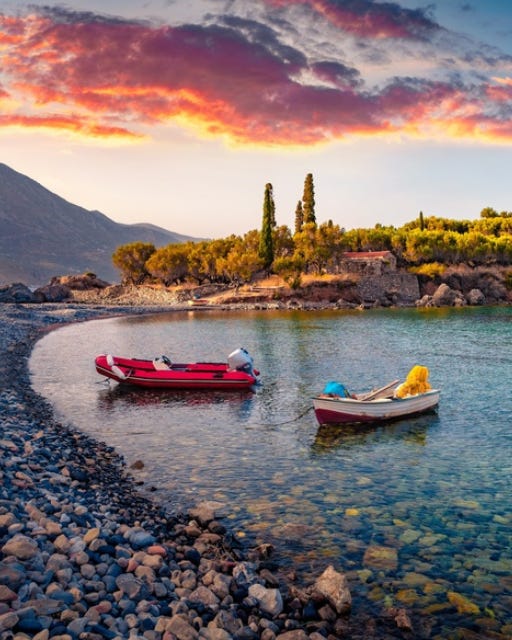
The Peloponnese is the large peninsula that forms the southern tip of mainland Greece, joined to the rest of the country by a narrow strip of land at Corinth and, since 1893, cut through by a deep canal. For most visitors flying into Athens, it sits just two to three hours away by road, yet it feels a world apart from the crowds of the capital and the party islands. This is a land of olive groves, empty coastal roads, walled towns, and some of the oldest ruins in Europe. The myths of Agamemnon, Helen, and Hercules were set here, and much of the stone behind those stories is still standing.
What makes the Peloponnese different is the sheer depth of its layers. In a single week you can stand inside a 3,300-year-old Bronze Age palace, sleep in a Venetian sea fortress, walk through a Byzantine ghost city, and eat lunch in a stone tower village that once ran on family feuds. These are not reconstructions or theme parks. They are working towns and protected sites where daily life carries on around the history. Because the region is spread out and served by good but quiet roads, it rewards a traveller who takes it slowly.
This route suits people who like to understand a place, not just photograph it. It works best with a hire car, a relaxed pace, and a willingness to eat late and start early. If you enjoy heritage, walking, good food, and coastline without the summer scrum, the Peloponnese gives you all four.
In This Email:
The Peloponnese: Five Stops on the Trail of Ancient Greece - Lets travel from the eastern coast down into the deep south and back up into the mountains. Each stop below can hold a full day or more, and together they form a natural loop you can drive without backtracking. Here is where we are going.
Nafplio
Mycenae
Monemvasia
The Mani (Areopoli and the tower villages)
Mystras
Suggested 5-day itinerary
When to visit and how to get there
