

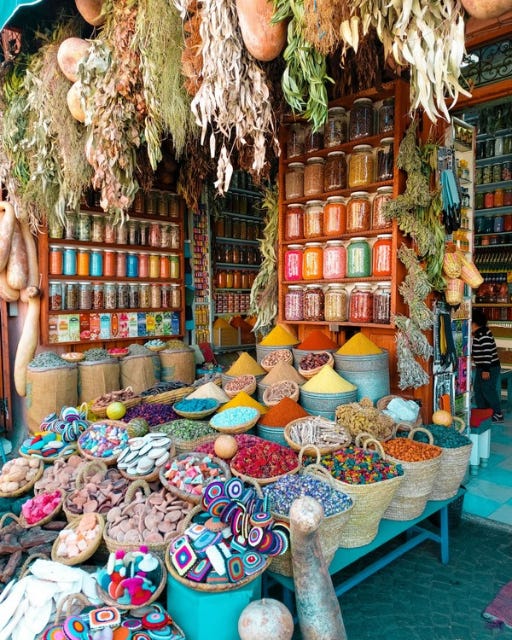
Morocco sits at the north-western corner of Africa, with the Atlantic on one side and the Mediterranean on the other. Spain lies just fourteen kilometres across the Strait of Gibraltar, yet the moment you arrive the country feels like its own world. For more than a thousand years it has been a meeting point for Berber, Arab, Andalusian, and African cultures, and that long mixing is written into its food, its music, its buildings, and its daily life. The result is a place that rewards attention and patience rather than a rushed checklist.
Most visitors begin in Marrakech, and it is easy to see why. The city is busy, colourful, and full of life. But Morocco is far larger and quieter than its most famous city suggests. Within a few hours of Marrakech you can stand in a Berber village high in the Atlas Mountains, walk through a medieval city that has barely changed in centuries, or watch the sun drop into the Atlantic from a windswept port town. The distances are manageable, and the contrasts are sharp.
This guide is for travellers who want to move slowly and look closely. It suits anyone more interested in the texture of a place than in ticking off famous sights. You do not need to be an experienced traveller to enjoy Morocco, but you will get more from it if you give it time, accept that plans sometimes change, and let the pace of each place set the tone.
In This Email:
Five places that show the real range of Morocco - Below you will find five places that together show the range of the country, from imperial cities to mountain valleys and the coast. Each section explains what the place is, why it matters, and what you can do there. After that you will find a practical itinerary, advice on when to go, and clear guidance on travel and timing.
Marrakech and its medina
Fez and the old city of Fes el-Bali
Aït Benhaddou, the earthen fortress village
The High Atlas and the valleys around Imlil
Essaouira on the Atlantic coast
A suggested five-day itinerary, when to visit, and how to get there
