

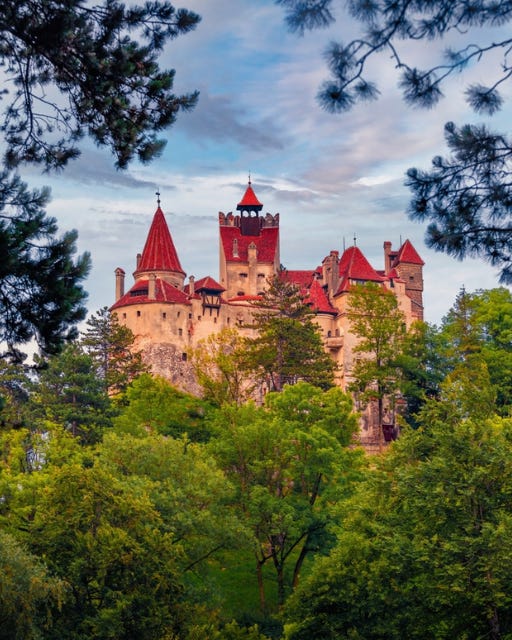
Transylvania sits in the centre of Romania, ringed by the arc of the Carpathian Mountains. The name is widely known, often through fiction, but the real region is quieter and far more interesting than the legends suggest. For more than 800 years it has been a meeting point of cultures: Romanian, Hungarian, Roma, and, most visibly in its architecture, German. In the 12th century, Hungarian kings invited settlers from the Rhine and Moselle valleys to develop and defend this frontier land. Those settlers became known as the Transylvanian Saxons, and the towns and villages they built still shape the landscape today.
What makes this part of Romania different is how much of that medieval world remains standing and in daily use. The Saxons built fortified churches at the centre of their villages, ringed by thick walls where whole communities could shelter during raids. They laid out orderly towns with guild halls, watchtowers, and wide central squares. Many of these survived the centuries because the region stayed rural and, for a long time, off the main tourist routes. Seven of the fortified church villages are now protected as a single UNESCO World Heritage Site, and the historic centres of Sibiu, Brașov, and Sighișoara remain remarkably complete.
This is a good region for slow travel. Distances are short, the roads pass through farmland and forest, and the towns are built for walking. It suits travellers who like history, architecture, and a strong sense of place, and who would rather spend an unhurried afternoon in one town square than rush between attractions. You do not need to be an expert in Central European history to enjoy it. You simply need a little time and a willingness to go at the region’s own steady pace.
In This Email:
Five Places Where Medieval Europe Still Stands - Below you will find five places that together tell the story of Saxon Transylvania, from its grandest city to one of its smallest villages. You will get a clear picture of what each place is, why it matters, and what you can see there. At the end, there is a realistic five-day itinerary, practical advice on when to visit, and guidance on getting there.
Brașov
Sibiu
Sighișoara
Viscri
Bran Castle
Suggested five-day itinerary to Transylvania’s Saxon Heart: a five-stop heritage route
When to visit Transylvania, how to get there and how long to spend
